 1-800-413-2579
Posted by Metro Screenworks on Sep 22nd 2026
How Does a Retractable Screen Door Work? Types, Sizes, and How to Choose
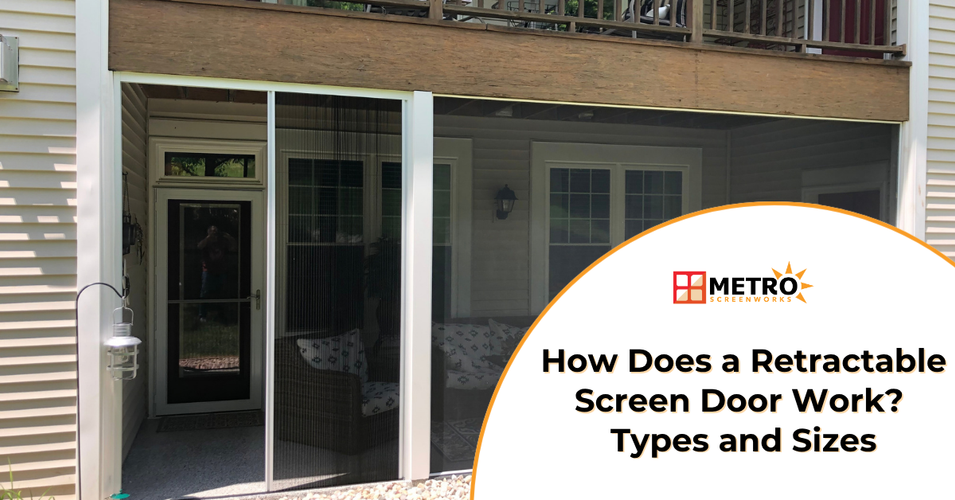
How does a retractable screen door work? A retractable screen extends across a door, window, or patio opening when needed, then rolls or folds back into a compact housing when not in use, leaving the opening clear.
Unlike a fixed screen door, a retractable screen gives you insect protection only when you want it. The right design depends on the type and size of your opening. Single doors, French doors, multi-panel sliders, accordion doors, patios, and windows can all require different retractable screen systems. Explore Metro Screenworks' retractable screens to compare options for different openings.
What Is a Retractable Screen Door?
A retractable screen door is a screen that can be pulled across an opening when you want fresh air and insect protection, then stored out of sight when you do not need it.
Depending on the system, the screen either rolls into a protective cassette or folds into itself in a pleated, accordion-style configuration. Because the mesh is stored when the screen is open, it is less exposed to sun and weather during periods when it is not being used.
Retractable screens are available for much more than traditional entry doors. They can be used with single doors, French doors, sliding doors, large multi-panel openings, porches, patios, and even windows.
They provide near-complete protection against insects when properly installed while maintaining airflow and visibility. When retracted, the screen leaves the opening unobstructed rather than permanently covering the doorway or view.
How Do Retractable Screen Doors Work?
Retractable screens move horizontally or vertically along guides that keep the screen aligned as it opens and closes. The exact mechanism depends on the screen.
Traditional retractable screen doors typically use mesh that rolls into a cassette, similar to the way a window shade rolls into its housing. Pleated retractable screens work differently. Instead of rolling around a tube, the screen folds into a compact accordion shape.
Both systems accomplish the same basic goal: provide screening when you want it and move the screen out of the way when you do not.
Roll-Up Screens That Retract Into a Cassette
A roll-up retractable screen uses flexible screen mesh attached to a roller inside a protective housing or cassette.
When you pull the screen across the doorway, the mesh unrolls from the cassette and moves through guides along the opening. When the screen is released or opened, it retracts back into the housing.
For example, the Genius Milano 100 single retractable screen door uses a protective housing and a patented speed reducer for controlled retraction. It also uses a full-length magnetic seal when closed. The Milano 100 is designed for single-door openings up to 60 inches wide and 100 inches tall.
This style works especially well for conventional entry doors where a compact cassette can be mounted along one side of the opening.
Pleated Screens That Fold Like an Accordion
Pleated screens use a different mechanism. Instead of winding around a roller, the mesh is permanently pleated so it can expand across the opening and fold back into itself when retracted.
The Genius ZIGZAG is an example of this design. Its single pleated panel glides horizontally along a low-profile bottom guide and can open from either end. When the screen is not needed, the pleated material gathers neatly into its housing rather than rolling around a tube.
The accordion-style construction is especially useful for wide openings. A pleated panel can span a much larger doorway than many conventional roll-up screen systems while still retracting into a relatively compact area.
That makes pleated retractable screens particularly useful for accordion doors, folding doors, multi-panel sliders, large patio openings, and other architectural openings where a standard single-door screen may not work.
Which Retractable Screen Fits Your Opening?
The most important factor when choosing a retractable screen is not simply the style you prefer. It is the size and configuration of the opening you need to screen.
Here is a quick starting point:
| Opening | Genius Product | Maximum Size | Starting Price |
|---|---|---|---|
| Single door | Milano 100 | 60" W x 100" H | $319.65 |
| French or double doors | Genius French / Milano 200 | 108" W x 100" H | $489.79 |
| Wide, accordion, folding, or multi-panel opening | ZIGZAG | 177" W x 118" H | $789.79 |
| Extra-wide opening | ZIGZAG TWO | Up to 315" W x 126" H | $1,799.47 |
| Very wide multi-panel opening | Sheer Classic | Up to 6 panels and 40 ft wide | From $650.30 |
Product specifications and prices can change, and custom configurations can affect final pricing. See each product page for current details.
Single Doors and Front Doors
For a standard front, side, balcony, or patio entry door, a single retractable screen is usually the simplest solution.
The Genius Milano 100 is made to size for single-door openings up to 60 inches wide and 100 inches tall. When closed, the mesh provides insect protection while allowing air into the home. When opened, the screen retracts into its housing so it does not remain in the doorway.
This makes a retractable screen door for a front door particularly useful when you want the benefits of a screen without permanently covering the appearance of the entryway.
French Doors and Double Doors
French doors create a different challenge because two operable doors occupy the same opening.
A retractable screen door for double doors can solve this with two retractable panels. Metro's Genius French retractable screen door, also known as the Milano 200, is designed for double-door openings up to 108 inches wide and 100 inches tall.
The screens move from opposite sides of the opening and meet at the center. A full-length magnetic connection holds the screens together when closed, while one panel can also be locked in place when desired.
This allows homeowners to keep the French-door layout while adding screening without installing a conventional sliding screen. For more detail, see Metro's guide to a retractable screen door for French doors.
Wide Openings, Accordion Doors, and Multi-Panel Sliders: The Genius ZIGZAG

The Genius ZIGZAG uses one pleated panel, so there is no center divide across the opening.
Large glass doors have changed what homeowners need from a screen.
Accordion doors, folding doors, and multi-panel sliders can create openings far wider than a standard entry door. Screening that space with traditional hinged or sliding doors can require several panels and interrupt the wide-open appearance that these doors were designed to create.
The Genius ZIGZAG retractable screen is designed specifically for this problem.
ZIGZAG uses one large pleated screen panel rather than a pair of screens meeting in the middle. The panel slides horizontally and can be opened from either end. It can cover the entire opening, remain partially extended, or retract completely when screening is not needed.
The single-panel configuration is one of its biggest advantages for homeowners who want a cleaner appearance across a large opening. There is no permanent center divide running vertically through the middle of the view.
ZIGZAG is custom-made to the net opening and is currently listed for openings up to 177 inches wide and 118 inches tall. It is pre-assembled, available in multiple frame colors, and designed for residential and light commercial applications. Metro lists its current starting price at $789.79.
Its low-profile bottom guide also allows the screen to travel smoothly across the opening while helping minimize gaps along the floor.
For especially large accordion or folding doors, hospitality spaces, and indoor-outdoor living areas, that combination of width and retractability can make ZIGZAG a more practical option than attempting to adapt a traditional retractable door screen to the opening.
One important limitation: retractable insect screens should not be treated as pet-containment systems. Even with a low bottom guide, a determined pet may be able to push beneath or around some screen configurations.
Extra-Wide Openings: The ZIGZAG TWO Double Retractable Screen Door
When an opening becomes too wide for a single pleated panel, the ZIGZAG TWO double retractable screen door divides the span between two panels.
Each pleated screen extends from one side of the opening and the two panels meet at the center. The panels can also be operated from either side, providing more flexibility in very large openings. Metro currently describes the ZIGZAG TWO system as suitable for openings up to 315 inches wide and 126 inches tall.
Splitting the screen into two panels also distributes the screen across the opening rather than requiring one extremely large panel to travel the entire distance.
ZIGZAG TWO is commonly used with multi-panel sliding glass doors, folding or accordion doors, and large residential or light commercial openings.
Like the single-panel ZIGZAG, it should be retracted when it is not in use and during high winds or hazardous weather. The current product page lists a starting price of $1,799.47.
Patios, Porches, and Windows
Retractable screening is not limited to conventional doors.
For large patios, porches, and panoramic openings, multi-panel systems such as the Genius Sheer Classic can accommodate configurations with as many as six panels and openings up to 40 feet wide. The system can be configured for single, French, multi-slide, bi-fold, and panoramic doorways.
Motorized retractable exterior shades are another option for larger outdoor living spaces where homeowners want a screen that moves vertically rather than horizontally.
Windows can also use retractable window screens. A retractable window screen provides screening while the window is open, then retracts when a clear view or access through the opening is preferred.
The important point is that "retractable screen" describes a family of products, not one universal mechanism. Door type, opening width, direction of travel, and accessibility needs should determine which system you choose.
ZIGZAG vs. ZIGZAG TWO: Which Do You Need?
The primary difference between ZIGZAG and ZIGZAG TWO is the number of panels and the width of opening each system is designed to cover.
| ZIGZAG | ZIGZAG TWO | |
|---|---|---|
| Panels | One pleated panel | Two pleated panels |
| Operation | Opens from either end | Panels extend from opposite sides and meet at center |
| Center break | No | Yes, when fully closed |
| Maximum published width | 177" | Up to 315" |
| Best for | Wide openings | Extra-wide openings |
| Current starting price | $789.79 | $1,799.47 |
Choose ZIGZAG when one panel can comfortably cover the opening and you want an uninterrupted single-screen appearance.
Choose ZIGZAG TWO when the opening is wider or when a center-opening configuration makes more sense for how people move through the space.
Are Retractable Screens Worth It?
For many homeowners, retractable screens are worth it when a traditional fixed or sliding screen would interfere with the opening, appearance, or view.
Their biggest advantage is flexibility. You can use the screen while the door or window is open, then retract it when it is no longer needed. That also stores the mesh away from direct exposure when the screen is not being used.
Retractable systems can also solve openings that are difficult to screen conventionally, including French doors, oversized doors, accordion doors, multi-panel sliders, and large patio openings.
There are trade-offs. Retractable screens generally cost more than basic fixed screens, accurate measurements are important, and the screen should not remain extended during strong winds or severe weather.
When comparing a magnetic screen door vs. retractable screen, a retractable system also provides a framed, made-to-fit installation rather than relying on a flexible temporary screen hanging within the doorway.
How to Measure and Install a Retractable Screen Door
Accurate measurements are critical because many retractable screens are manufactured specifically for the opening.
For a ZIGZAG system, first make sure the opening is plumb, level, and square. The bottom guide also needs a flat, solid surface.
Measure the net opening, including both width and height, from the outside edges of the area where the screen will sit. Metro's ZIGZAG instructions call for deducting 1/16 inch from both width and height for manufacturing tolerance.
Installation varies by product, so follow the instructions for the specific retractable screen you purchase rather than applying one installation method to every model.
Metro provides a measure for retractable screens resource and a separate guide explaining how to install a retractable screen door. The existing installation guide covers the Milano 100 specifically, while ZIGZAG systems have their own installation documentation.
Frequently Asked Questions
How does a retractable screen door work?
A retractable screen moves across a door opening when screening is needed and stores out of the way when it is not. Some screens roll into a cassette using a roller mechanism. Others, including ZIGZAG, use pleated mesh that folds together like an accordion as the screen retracts.
What is the difference between ZIGZAG and ZIGZAG TWO?
ZIGZAG uses one pleated screen panel and has no center division. ZIGZAG TWO uses two panels that extend from opposite sides and meet in the center. ZIGZAG is designed for wide openings, while ZIGZAG TWO can accommodate substantially larger spans.
Can a retractable screen cover an accordion or folding door?
Yes. Pleated systems such as the Genius ZIGZAG are specifically suited to accordion doors, folding doors, multi-panel sliders, and other wide openings. The screen can extend across the opening when needed and retract when the doors are fully opened.
Do retractable screens keep bugs out?
Retractable screens are designed to provide insect protection when properly measured, installed, and closed. Systems such as ZIGZAG use a low-profile bottom guide to reduce gaps along the floor. They are insect screens, however, and should not be considered impenetrable barriers or guaranteed pet-containment systems.
How long does it take to get a ZIGZAG screen?
The current Metro Screenworks product page lists a 5 to 6 week lead time for the single-panel ZIGZAG. ZIGZAG screens are custom-made and ship directly to the customer rather than being available for in-store pickup.
Should I leave a retractable screen extended?
Retract the screen when it is not being used and during high winds or hazardous weather. Keeping the screen stored when it is not needed also reduces unnecessary exposure of the mesh and moving components.
Find the Right Retractable Screen for Your Opening
The best retractable screen depends on the opening you need to cover. Standard single doors can usually use a roll-up retractable screen, French doors need a double-door configuration, and wide accordion, folding, and multi-panel doors may call for a pleated system such as ZIGZAG or ZIGZAG TWO.
Start by measuring your opening and identifying how you want the screen to operate. Then compare Metro Screenworks' retractable screens or request a quote for a wide or unusual opening.
If you are unsure which system or measurements you need, Metro Screenworks can also provide measuring assistance at 1-800-413-2579.