 1-800-413-2579
Posted by Metro Screenworks on Aug 31st 2026
Types of Vinyl Rolls: How to Choose the Right One
Clear vinyl rolls come in three main types: standard, tinted, and fire retardant. Within each type, gauge determines how thick and rigid the material is. Thinner vinyl can work with spline, while thicker vinyl usually needs to be stapled, grommeted, or screwed to a frame.
That means choosing the right clear vinyl is really two decisions: which type fits your environment, and which gauge fits your project and installation method. If you are still comparing your options, browse Metro Screenworks' clear vinyl rolls before narrowing down the right material.
What Does Gauge Mean in Vinyl?
What does gauge mean in vinyl? Gauge is a way of describing vinyl thickness. The higher the gauge number, the thicker and more rigid the clear vinyl material will be. This is the opposite of many metal gauge systems, where a higher number can indicate a thinner material.
Vinyl gauge thickness matters because it changes how the material behaves. A lighter gauge bends, drapes, and stretches more easily. A heavier gauge holds its shape better, provides a more substantial barrier, and usually requires a different attachment method.
Gauge and mil are also not technically the same measurement. Our material supplier notes that mil measurements run roughly 6 to 12 percent thicker than the corresponding gauge designation and identifies millimeters as the most accurate way to compare actual material thickness. Clear vinyl is also an extruded product, so small variations in finished thickness can occur from one production run to another.
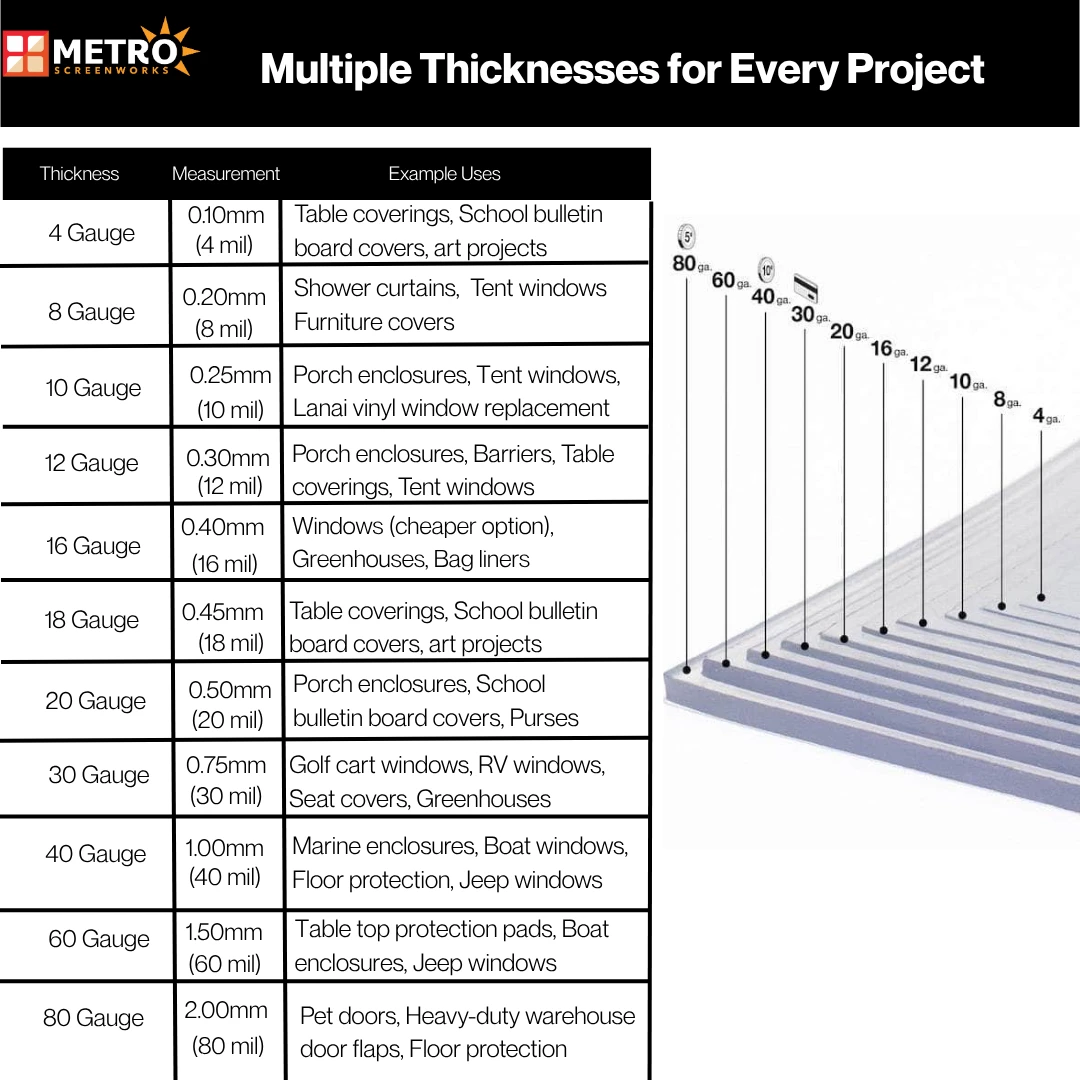
For reference, 20 gauge clear vinyl measures approximately 0.50 mm, or 0.02 inch, thick. Thirty gauge measures approximately 0.75 mm, or 0.03 inch, and 40 gauge measures approximately 1.00 mm, or 0.04 inch. Metro often compares 30 gauge vinyl to the familiar thickness of a credit card.
The practical takeaway is simpler than the terminology: a higher gauge means thicker vinyl. Start with how the material needs to perform and how you plan to install it, then choose the gauge.
The Three Types of Clear Vinyl Rolls
Clear vinyl is not one universal material. Metro offers different versions for different environments, and choosing the right type matters just as much as choosing the right gauge.
| Type | Best for | Gauges offered | Widths | Trade-off |
|---|---|---|---|---|
| Standard Clear Vinyl | Porches, marine enclosures, tables, barriers and general projects | 4, 8, 10, 12, 16, 20, 30, 40, 60, 80 | 54 inches across the range; 72 inches on select gauges | No added tint or fire-retardant formulation |
| Tinted Clear Vinyl | Privacy, glare reduction and spaces where full transparency is not preferred | Varies | Varies | Reduces some incoming light |
| Fire Retardant Clear Vinyl | Applications where a fire-retardant material or documented testing is required | 10, 20, 30, 40 | 54 and 72 inches; 90 inches on 20 gauge | Smaller gauge range and requirements vary by application |
Standard Clear Vinyl
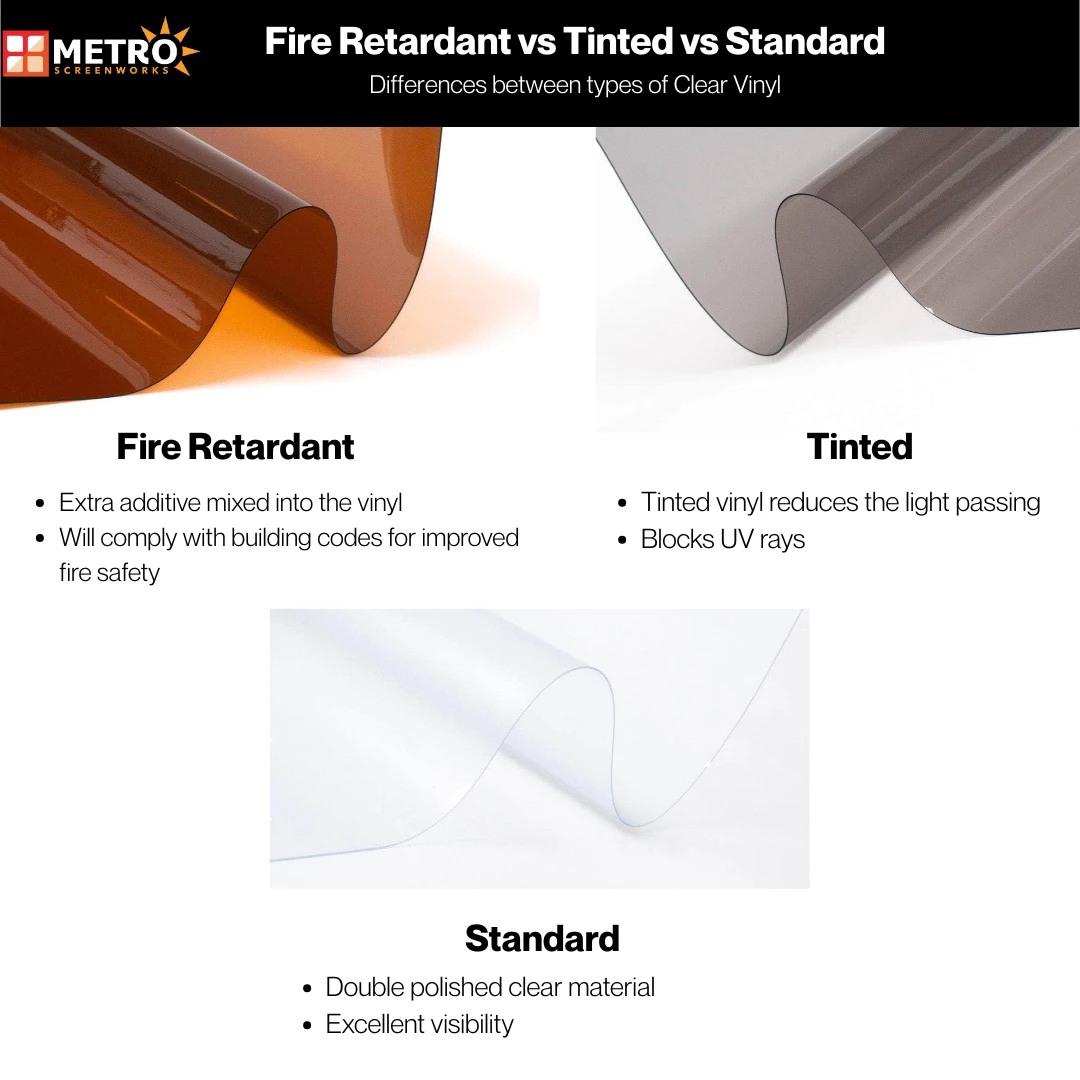
Standard clear vinyl is the most versatile option for projects where visibility and weather protection are the priority. Metro's standard clear vinyl roll is double polished, UV treated, waterproof, and available in gauges ranging from lightweight 4 gauge through heavy-duty 80 gauge.
Most gauges are available in 54-inch widths, with 72-inch widths offered on 10 and 20 gauge material. Because the gauge range is so broad, the same general type of clear vinyl material can serve very different purposes.
The material is double polished and extruded, with 500-hour UV resistance and a cold crack rating of -40°F under CFFA-6A testing. It uses DOTP plasticizer and is described by the supplier as lead and phthalate free, with CPSIA and REACH compliance.
The cold-weather performance is particularly useful for porch and enclosure applications where vinyl may remain exposed during winter. Thin material can handle table coverings, light barriers, and projects that need flexibility, while heavier gauges are better suited to framed enclosures and substantial protective surfaces.
Tinted Clear Vinyl
Tinted clear vinyl serves a different purpose. Instead of maximizing light transmission, it introduces tint to provide more privacy and reduce glare while still allowing a view through the material.
That makes tinted vinyl useful for porches, patios, outdoor living areas, or other spaces where completely clear panels may feel too exposed. It can also help limit UV exposure inside an enclosure, which may be useful around furniture, flooring, and other materials affected by prolonged sunlight.
There is a trade-off. Adding tint means giving up some light transmission compared with standard clear vinyl. How noticeable that difference feels depends on the application, the amount of surrounding natural light, and the specific tint.
For that reason, buyers choosing between clear and tinted material should think about the space itself. If preserving the brightest possible view is the priority, standard clear vinyl is usually the straightforward choice. If privacy or glare control matters more, tinted vinyl may make more sense.
Fire Retardant Clear Vinyl
Fire retardant clear vinyl is intended for projects where the material's fire performance matters. Metro currently offers this version in 10, 20, 30, and 40 gauge, with 54-inch and 72-inch widths plus a 90-inch width on select 20 gauge material.
Fire retardant does not mean fireproof. The fire-retardant version includes an additive mixed into the vinyl that changes how quickly it responds when exposed to flame. Regular clear vinyl can melt when exposed to flame, and the additive is intended to slow that process rather than prevent melting entirely.
Supplier documentation includes ASTM E84 fire testing as well as additional testing related to motor vehicle fire performance, California Technical Bulletin 117, CPSIA children's safety requirements, water resistance, cold crack performance, and weathering.
Requirements still vary by jurisdiction, building type, occupancy, and application. If your project is subject to a fire or building code, confirm the required material standard with your local building department or other authority before ordering. A material test does not mean a product automatically meets every local code.
What Gauge Clear Vinyl Do I Need? Match the Gauge to the Project
The easiest way to choose clear vinyl is to work backward from the project. Instead of asking what each gauge can do, start with what you are building and how the vinyl will be attached.
| Project | Recommended gauge | Thickness | Typical attachment |
|---|---|---|---|
| Spline-installed porch panel | 10 to 20 gauge | 0.25 to 0.50 mm | Spline |
| Framed porch or patio enclosure | 30 gauge and up | 0.75 mm and up | Staples, grommets or screws |
| Boat enclosure | 40 or 60 gauge | 1.00 or 1.50 mm | Framed or mechanically fastened |
| Greenhouse or shelter | 16 to 80 gauge depending on frame | 0.40 to 2.00 mm | Spline, staples or screws |
| Table covering or craft use | 4 to 12 gauge | 0.10 to 0.30 mm | Draped or cut to size |
| Rigid table protection | 60 or 80 gauge | 1.50 or 2.00 mm | Cut to fit |
Porch and Patio Enclosures
For porch applications, the installation method usually narrows the gauge range immediately.
If the clear vinyl needs to fit into a spline channel, lighter gauges are the better fit. Metro lists 10, 12, 16, and 20 gauge clear vinyl among the options commonly associated with spline-installed applications.
For a more substantial framed enclosure, 30 gauge clear vinyl is one of Metro's most popular choices. At approximately 0.75 mm thick, it provides more structure while remaining workable for porch applications. It can be installed using staples, grommets, screws, or similar mechanical fastening methods rather than spline.
Moving into 40 or 60 gauge gives you heavier, more rigid material. These gauges can make sense when creating a more substantial cold-weather barrier and when the frame and attachment method can support thicker vinyl. Our supplier also identifies 30 and 40 gauge as common patio-enclosure thicknesses.
If you would rather order a finished solution instead of building panels from a roll, compare Metro's vinyl porch panels and porch panels with clear vinyl.
Boat and Marine Enclosures
For boat enclosures, thicker clear vinyl is common because the material needs to hold its shape while maintaining a clear view.
Metro identifies 40 gauge clear vinyl as a popular option for boat and marine enclosure applications. At approximately 1.00 mm thick, it provides substantially more rigidity than the gauges commonly used with spline. Common applications include biminis, sail windows, dodgers, and cockpit enclosures.
For an even heavier-duty panel, 60 gauge clear vinyl is another option. It measures approximately 1.50 mm thick.
The material is press polished and manufactured using a water-bath cooling process designed to reduce air bubbles and support optical clarity, an important consideration when the vinyl is being used around a helm or sightline.
Boat owners should also keep realistic expectations about clarity over time. Like other flexible clear vinyl materials, panels do not remain unchanged forever. More on that below.
Greenhouses and Animal Shelters
Clear vinyl for greenhouse frames, hoop houses, chicken coops, and animal shelters can range from relatively flexible material to very heavy gauges.
Sixteen and 20 gauge vinyl can work where material needs to stretch across a frame or remain relatively flexible. Heavier 30, 40, 60, and 80 gauge material can be stapled, screwed, or otherwise mechanically fastened to a more substantial structure.
The material's documented 500-hour UV resistance is relevant for applications that spend significant time outdoors, although exposure conditions still vary considerably from one project to another.
For a temporary or seasonal enclosure, flexibility may matter more than maximum thickness. For a permanent or exposed frame, a thicker sheet and stronger mechanical attachment may be the better combination.
Always choose the installation method and frame design before buying the thickest available material. More thickness is not automatically better if the material cannot be attached correctly.
Table Covers, Barriers, and Craft Uses
The thinnest clear vinyl rolls are often the best match for projects that need to bend, drape, or conform to a surface.
Four gauge measures approximately 0.10 mm and 8 gauge measures approximately 0.20 mm. These lighter options can work for table coverings, bulletin board covers, art projects, and similar uses. Eight, 10, and 12 gauge options are flexible enough to drape over a table edge more naturally than heavier material.
For clear vinyl curtains or safety barriers, a mid-range gauge provides more structure without becoming as rigid as heavy enclosure material. Metro also identifies 16 gauge as an option for barrier applications.
At the opposite end, 60 and 80 gauge material can serve as a thick protective layer cut to the top of a table. At approximately 1.50 mm and 2.00 mm respectively, these gauges are better used as pads than tablecloths because they are too rigid to drape naturally over an edge.
Heavy 80 gauge vinyl can also be used for applications such as pet doors and warehouse-style flaps.
The supplier also identifies the clear vinyl as CPSIA compliant and lead and phthalate free, which may be relevant for buyers considering the material for household surfaces or environments used by children.
How the Vinyl Attaches Changes Which Gauge You Need
The attachment method may be the most important constraint in the entire buying process.
Thinner vinyl is flexible enough to work with screen spline and similar channels. Once the material gets thicker, it becomes more difficult or impossible to press it into a standard spline track.
That is why many projects using 10 through 20 gauge vinyl can rely on spline, while heavier material is more often stapled, grommeted, or screwed directly to a frame.
A common mistake is choosing the gauge first, then discovering that the material cannot work with the planned installation.
Reverse the process:
- Decide how the vinyl will mount.
- Choose the gauge range compatible with that method.
- Choose standard, tinted, or fire retardant material.
If the enclosure uses flat vinyl tracking or an existing screen-frame system, confirm its material limits before ordering the roll.
For some window applications, controlled heat from a heat gun or steamer can soften the vinyl and make it easier to achieve a smooth stretch. Use heat carefully and follow the applicable installation instructions to avoid overheating or damaging the material.
Clear Vinyl vs. Vinyl Mesh vs. Florida Glass
Clear vinyl, vinyl mesh, and Florida Glass are sometimes grouped together because all three appear in porch and outdoor applications. They perform very different jobs.
| Material | Breathable | Blocks weather | See-through | Typical use |
|---|---|---|---|---|
| Clear vinyl | No | Yes | Transparent | Seasonal enclosures, windows and weather barriers |
| Phifertex vinyl mesh | Yes | No | Partially | Shade, airflow and durable outdoor screening |
| Florida Glass | Limited | Partially | Reduced | Privacy, lower porch panels, pool cages and splash/debris control |
Clear vinyl is a solid, non-breathable sheet. It blocks wind and water and is the right category when the goal is creating an enclosed barrier.
Phifertex vinyl mesh is a woven vinyl-coated fabric. Air still moves through it, so it works for screening and shade rather than weather enclosure.
Florida Glass screen starts with screen mesh and adds a laminated vinyl backing. It is commonly used where additional privacy and resistance to water or debris are useful, but it does not create the same fully clear enclosure as solid vinyl.
What to Expect: Shrinkage, Yellowing, and Lifespan
Clear vinyl is useful because it is flexible, transparent, and easier to work with than rigid glazing. Those same material characteristics also mean it should not be treated like permanent glass.
Clear vinyl can shrink slightly after being tightly wound on a roll. Let the material unroll and relax before final measuring and cutting, especially if it has been stored tightly rolled. High-heat storage conditions can accelerate material changes, so avoid leaving rolls in hot attics, sheds, or similar spaces when possible.
Clear vinyl also eventually yellows and becomes more brittle. Plasticizers gradually break down under UV exposure and normal aging. This happens to flexible clear vinyl regardless of quality, although environmental conditions and material care influence how quickly the change becomes noticeable.
There is no responsible universal lifespan in years. Sun exposure, temperature, storage, cleaning, and how the panel is handled all affect its useful life.
Storage matters too. Remove packaging paper after delivery rather than leaving it pressed against the vinyl for long periods. Store rolled vinyl standing vertically or hanging when practical, and avoid keeping it flat under heavy pressure. Prolonged pressure can leave cloudy or distorted areas in the material.
How to Cut, Store, and Clean Clear Vinyl
Do not use Windex, bleach, or other harsh household cleaners on clear vinyl. These products can damage flexible vinyl and shorten its useful life.
For routine cleaning, use mild dish soap, warm water, and a soft cloth. Dedicated marine-vinyl cleaners and protectants from brands such as 303 or IMAR are also commonly used when soap and water are not enough.
For cutting, place the clear vinyl on a clean, flat surface and use a sharp blade with a straightedge. Give tightly rolled material time to relax before making final measurements or cuts.
Avoid folding heavy clear vinyl whenever possible. Roll it carefully for storage and keep it protected from heat, crushing, and prolonged pressure.
Frequently Asked Questions
What does gauge mean in clear vinyl?
Gauge describes the thickness of clear vinyl. A higher gauge means thicker, more rigid material. Gauge affects how easily the vinyl bends, which installation methods it can use, and which types of projects it suits.
How thick is 20 gauge clear vinyl?
Twenty gauge clear vinyl is approximately 0.50 mm, or 0.02 inch, thick. It is flexible enough for many spline-installed applications while still providing more structure than lightweight craft gauges.
How thick is 30 gauge clear vinyl?
Thirty gauge clear vinyl measures approximately 0.75 mm, or 0.03 inch, thick. Metro compares it to the familiar thickness of a credit card and identifies it as a top-selling option for porch enclosures.
How thick is 40 gauge clear vinyl?
Forty gauge clear vinyl measures approximately 1.00 mm, or 0.04 inch, thick. Metro identifies 40 gauge as a popular option for boat and marine enclosure applications.
Is gauge the same as mil?
Not exactly. Our material supplier notes that mil measurements can run roughly 6 to 12 percent thicker than the gauge designation. Millimeters provide the clearest way to compare the actual thickness of clear vinyl.
What gauge clear vinyl is best for a porch enclosure?
It depends on how the panel attaches. Lighter gauges up to 20 gauge can work with spline systems. Metro identifies 30 gauge as a popular porch-enclosure choice when the material is stapled, grommeted, screwed, or otherwise mechanically fastened.
What gauge vinyl should I use for boat windows?
Metro identifies 40 gauge clear vinyl as a popular option for marine enclosures, while 60 gauge provides a thicker, heavier-duty alternative. The best choice depends on the enclosure design, framing, visibility needs, and attachment method.
What is the difference between standard, tinted, and fire retardant clear vinyl?
Standard clear vinyl maximizes transparency for general applications. Tinted vinyl adds privacy and glare reduction while allowing a view. Fire retardant vinyl contains an additive intended to slow the material's response to flame, but it is not fireproof and should be matched to applicable local requirements.
Does clear vinyl turn yellow?
Yes. Flexible clear vinyl eventually yellows and can become brittle as plasticizers break down and the material experiences UV exposure and normal aging. No universal number of years applies because exposure, climate, storage, and maintenance vary.
Can clear vinyl be installed with spline?
Yes, but gauge matters. Thinner vinyl is flexible enough for many spline channels. Once the material becomes too thick and rigid, mechanical attachment methods such as staples, grommets, or screws are generally more appropriate.
Choose the Installation First, Then the Vinyl
The easiest way to choose clear vinyl is to make the decisions in the right order. Start with how the material needs to mount. That determines the practical gauge range. Then choose standard, tinted, or fire retardant vinyl based on the environment.
If you are stuck between two gauges, a physical sample is often more useful than trying to picture the difference from a number. Request a sample to compare the material in person, or browse Metro Screenworks' full selection of clear vinyl rolls for your next project.